Well, today is the last day of November and the last day of NaBloPoMo. That's five posts in five weeks (including this one). How did it go?
Firstly, it's worth acknowledging that this has been the worst month for this kind of thing. I've been on leave for one week, and away for a few weekends so my normal writing topics and opportunities have been thrown to the winds. Couple this with some extremely difficult weeks in the office giving me no desire whatsoever to write in the evenings and let's just say that it hasn't been easy.
On the positive side, it has been nice to see my blog grow more quickly, I don't think the less thought out posts have been much worse, and I have enjoyed experiencing this with the small community that has attempted NaBloPoMo. I'm also pleased that I have managed to set myself a goal and achieve it (posting on each weekend) even if I did cheat a bit with one of the posts.
On other hand, the pressure to write when I haven't felt like writing has been a bit of a problem. This is the motivation I use throughout the year, however committing to a monthly post means I have weekends free in between so this cadence is less intrusive. I've definitely made decisions to write over doing something else (such as coding) over this period purely because of the challenge and even as I write this I know I'd rather be cooking and playing on a MUD - I'm putting off fun and relaxation in order to write this reflection. When I'm at low energy and low ebb (such as now) this can be dangerous so I'm glad it's only a few weeks - and even more so that I didn't even attempt a daily post. I think that would require a radically different approach to blogging from me.
So will I do it again? Probably. I'm not likely to push it too hard if I'm on my own, but if a group is keen to give it a go again next year I'll be on board. I guess what I'm saying is that the true spirit of NaBloPoMo is the friends made along the way.
And I still hate the name.
This post is the fifth of five written in NaBloPoMo - the National Blogpost Month which, yes, is a thing. My plan is to write one post a weekend for the month of November. Due to some amazing planning, that means I have to write five posts rather than the four you might immediately expect. These posts will be a bit shorter than normal most likely and all of the posts will be tagged with (sigh) NaBloPoMo2019.
Saturday, 30 November 2019

Sunday, 24 November 2019
Failing to relax
This is going to be a brain dump and may not have an actual point. You have been warned.
I've just had a week off work. Time to relax, recharge and reset. Only ... it hasn't worked. My normal pattern for time off is a few days doing very little, then I'm ready to re-engage with the world around me and I get a few days doing some kind of chunky project. This time, it took until Thursday before I managed to think about dragging myself back into the real world and I found myself wishing my week off was starting at the end of the week.
At the same time, the various activities I use to enthuse myself haven't worked either. I can't write, as the two main outputs for my writing are this blog and RPGs. This blog is increasingly (and deliberately) distilling my thinking and learning from the office which is very useful in general, but not something I want to be writing when I'm supposed to be disconnected from work.
My life in roleplaying games at the moment is largely dead, thanks to weird work / life patterns so there isn't much scope for writing there. Even when I do get into a game, I find myself wanting to hide at the back more than I used to. I don't fancy playing a character making significant decisions that can affect large groups of people when that is literally my day job these days.
I can turn to coding. Unfortunately, I'm between projects at the moment and starting a new one is much less fun than writing some code to fix specific problems. Anyway, writing code is hardly the best way to avoid thinking of work - last time I picked anything up, I spent my time looking at testing infrastructure and different ways of populating test data.
This leaves me in a difficult position. There is a hard question about what I actually do to relax. But more importantly, I think I need to ask some very pointed questions about why it is so hard in the first place. Why does it take a whole week away from work before I feel like I've actually left? Am I really saying that I should only take holiday in two week blocks? That doesn't seem healthy - if true, it feels like work is taking far too much out of me on an ongoing basis. So what do I do about that? What CAN I do about that? Wouldn't it be great if I had an answer to that question?
Still, I got a blog post out of it...
This post is the fourth of five written in NaBloPoMo - the National Blogpost Month which, yes, is a thing. My plan is to write one post a weekend for the month of November. Due to some amazing planning, that means I have to write five posts rather than the four you might immediately expect. These posts will be a bit shorter than normal most likely and all of the posts will be tagged with (sigh) NaBloPoMo2019.
I've just had a week off work. Time to relax, recharge and reset. Only ... it hasn't worked. My normal pattern for time off is a few days doing very little, then I'm ready to re-engage with the world around me and I get a few days doing some kind of chunky project. This time, it took until Thursday before I managed to think about dragging myself back into the real world and I found myself wishing my week off was starting at the end of the week.
At the same time, the various activities I use to enthuse myself haven't worked either. I can't write, as the two main outputs for my writing are this blog and RPGs. This blog is increasingly (and deliberately) distilling my thinking and learning from the office which is very useful in general, but not something I want to be writing when I'm supposed to be disconnected from work.
My life in roleplaying games at the moment is largely dead, thanks to weird work / life patterns so there isn't much scope for writing there. Even when I do get into a game, I find myself wanting to hide at the back more than I used to. I don't fancy playing a character making significant decisions that can affect large groups of people when that is literally my day job these days.
I can turn to coding. Unfortunately, I'm between projects at the moment and starting a new one is much less fun than writing some code to fix specific problems. Anyway, writing code is hardly the best way to avoid thinking of work - last time I picked anything up, I spent my time looking at testing infrastructure and different ways of populating test data.
This leaves me in a difficult position. There is a hard question about what I actually do to relax. But more importantly, I think I need to ask some very pointed questions about why it is so hard in the first place. Why does it take a whole week away from work before I feel like I've actually left? Am I really saying that I should only take holiday in two week blocks? That doesn't seem healthy - if true, it feels like work is taking far too much out of me on an ongoing basis. So what do I do about that? What CAN I do about that? Wouldn't it be great if I had an answer to that question?
Still, I got a blog post out of it...
This post is the fourth of five written in NaBloPoMo - the National Blogpost Month which, yes, is a thing. My plan is to write one post a weekend for the month of November. Due to some amazing planning, that means I have to write five posts rather than the four you might immediately expect. These posts will be a bit shorter than normal most likely and all of the posts will be tagged with (sigh) NaBloPoMo2019.
Tuesday, 19 November 2019
Fun in the cold, dark mud
Over the summer, while staying at Lee Abbey, I went to a short daily exercise class which consisted of 15 minutes of flailing around to music. A short and stupid conversation with a friend from Bath later, and I found myself charged with setting up a similar session in Bath. Except weekly, and for longer.
This is going to be a "how to run an exercise class" post. Before we get going there needs to be a MASSIVE DISCLAIMER that I am not in any way trained, qualified or insured. If you do anything here, or indeed turn up to the session you do so at your own risk.
That out of the way, this is how I run a high intensity training session.
The hardest part is the location. I'm lucky enough to live within easy walk of Victoria Park in Bath, which is an expanse of grass big enough to play some music without bothering anyone other than the ducks and a few dogs. As the weather gets worse it's going to be interesting. We're already coming back covered in mud so I'm polling all the attendees to see who has access to places with a roof. We meet at 8.30 on a Saturday morning, because who wants to be in bed when you can be cold and wet in the dark?
Most of the fun comes from convincing folk to join the group. We stay in contact via a WhatsApp group for instance messaging, and faster excuses. The groups has about 10 people in it, and I reckon about half have ever turned up.
I've chosen to run the sessions in a tabata format. That is, for each exercise we do 8 runs of 20 seconds with a 10 second rest in between. In theory, the first is supposed to be hit hard to a target for the next 7 but that is something that varies from person to person. We do 8 exercises, plus a warm-up and warm-down and the whole thing last about 45 mins.
This isn't true tabata - it goes on for far too long, for one. But nobody wants to go out to the park in the dark and wet for 5 mins.
If you've been to an exercise class in the past you'll know the basic exercises. We don't do anything clever, and certainly nothing that needs any skill to teach. I trawled the internet, looking for sites with some interesting exercises on them that do not require any equipment and came up with a list. I remix the set slightly each week, to get a blend of hard cardio and more strength based routines and they go on my exercise spreadsheet, because my life is spreadsheets. That sheet has a few workable sessions, if you'd like something to get started as well as links to the sessions on Interval Timer (see below).
To run the session, I use a couple of apps on my phone and a bluetooth speaker. My speaker of choice is the Anker Soundcore because it's waterproof and apparently runs on magic dust as it never, ever needs charging.
I use Google Play for the music (see below) and Seconds Pro as the timer (also available on iOS). This does cost the princely sum of £4.50, but for the cost of a beer it's great.
The secret weapon of all this is the site Interval Timer. This allows me to create the classes on a desktop PC before uploading them to my phone (by emailing myself the link). All I need to do on the phone is remember to turn on the audio alerts in the setup for the individual routine.
Finally, the music. Some people think you can exercise to anything. They are wrong. There is a perfect balance of beats per minute, high energy, and emphasis on the treble so it cuts through as everything goes dark. Most important is that it infuriatingly tugs at your memory because you KNOW this song but you can't remember WHERE FROM or WHAT IT IS but while you're thinking about that you're not thinking about the fact you're lying in cold mud in the dark at 8.30 on a Saturday morning.
Basically, you want 90s dance music. If you're not thinking about Saturday Night or remembering that Rhythm is a Dancer, you're doing it wrong.
And that is it! Walk to the park, connect the speaker, start the music, start the timer and off you go!
With success, you too could create something wonderful like this:
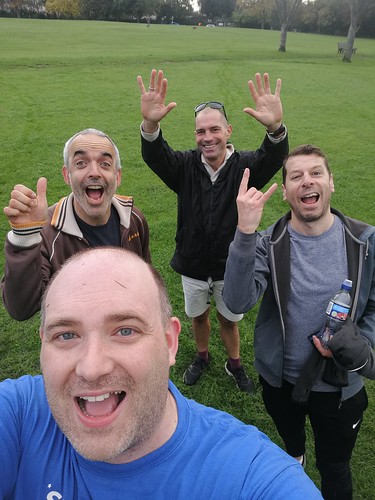
This post is the third of five written in NaBloPoMo - the National Blogpost Month which, yes, is a thing. My plan is to write one post a weekend for the month of November. Due to some amazing planning, that means I have to write five posts rather than the four you might immediately expect. These posts will be a bit shorter than normal most likely and all of the posts will be tagged with (sigh) NaBloPoMo2019.
This is going to be a "how to run an exercise class" post. Before we get going there needs to be a MASSIVE DISCLAIMER that I am not in any way trained, qualified or insured. If you do anything here, or indeed turn up to the session you do so at your own risk.
That out of the way, this is how I run a high intensity training session.
Time and place
The hardest part is the location. I'm lucky enough to live within easy walk of Victoria Park in Bath, which is an expanse of grass big enough to play some music without bothering anyone other than the ducks and a few dogs. As the weather gets worse it's going to be interesting. We're already coming back covered in mud so I'm polling all the attendees to see who has access to places with a roof. We meet at 8.30 on a Saturday morning, because who wants to be in bed when you can be cold and wet in the dark?
Community and communications
Most of the fun comes from convincing folk to join the group. We stay in contact via a WhatsApp group for instance messaging, and faster excuses. The groups has about 10 people in it, and I reckon about half have ever turned up.
Exercise routines
I've chosen to run the sessions in a tabata format. That is, for each exercise we do 8 runs of 20 seconds with a 10 second rest in between. In theory, the first is supposed to be hit hard to a target for the next 7 but that is something that varies from person to person. We do 8 exercises, plus a warm-up and warm-down and the whole thing last about 45 mins.
This isn't true tabata - it goes on for far too long, for one. But nobody wants to go out to the park in the dark and wet for 5 mins.
If you've been to an exercise class in the past you'll know the basic exercises. We don't do anything clever, and certainly nothing that needs any skill to teach. I trawled the internet, looking for sites with some interesting exercises on them that do not require any equipment and came up with a list. I remix the set slightly each week, to get a blend of hard cardio and more strength based routines and they go on my exercise spreadsheet, because my life is spreadsheets. That sheet has a few workable sessions, if you'd like something to get started as well as links to the sessions on Interval Timer (see below).
Running the session
To run the session, I use a couple of apps on my phone and a bluetooth speaker. My speaker of choice is the Anker Soundcore because it's waterproof and apparently runs on magic dust as it never, ever needs charging.
I use Google Play for the music (see below) and Seconds Pro as the timer (also available on iOS). This does cost the princely sum of £4.50, but for the cost of a beer it's great.
The secret weapon of all this is the site Interval Timer. This allows me to create the classes on a desktop PC before uploading them to my phone (by emailing myself the link). All I need to do on the phone is remember to turn on the audio alerts in the setup for the individual routine.
Bring the noise
Finally, the music. Some people think you can exercise to anything. They are wrong. There is a perfect balance of beats per minute, high energy, and emphasis on the treble so it cuts through as everything goes dark. Most important is that it infuriatingly tugs at your memory because you KNOW this song but you can't remember WHERE FROM or WHAT IT IS but while you're thinking about that you're not thinking about the fact you're lying in cold mud in the dark at 8.30 on a Saturday morning.
Basically, you want 90s dance music. If you're not thinking about Saturday Night or remembering that Rhythm is a Dancer, you're doing it wrong.
And happiness!
And that is it! Walk to the park, connect the speaker, start the music, start the timer and off you go!
With success, you too could create something wonderful like this:
This post is the third of five written in NaBloPoMo - the National Blogpost Month which, yes, is a thing. My plan is to write one post a weekend for the month of November. Due to some amazing planning, that means I have to write five posts rather than the four you might immediately expect. These posts will be a bit shorter than normal most likely and all of the posts will be tagged with (sigh) NaBloPoMo2019.
Sunday, 10 November 2019
Governance or trust?
Since this series seems to be "Tom has a half-formed thought" let's look at governance vs trust. I regularly find myself having to find a comfortable place between the two and it's an interesting balancing act.
At one end of this spectrum, people rightly want to be trusted (and feel trusted, but that's a different post). When I ask "is X in a good place?" and the answer is "yes" that should be enough for me. My leadership team is highly skilled and I do trust them to do the right things.
However, at the other end of this spectrum, good governance tells me that I should have extensive metrics in place for the definition of "good" and that data flows straight to me so I don't have to ask this question, I can just look. I've already asked "give me these metrics and that will show me what you're doing".
I don't like either approach. I am not doing my job correctly if I don't have a clear understanding of what my technical leadership is doing and the decisions they are making. I also can't represent them effectively to the wider organisation without more detailed information. Ultimately, this hands-off approach leaves everyone at risk - while one can't really do the wrong thing when there are no parameters, with no specific questions being asked or answered, it's impossible to say someone did the right thing either. This is a serious problem when something goes wrong - and something always goes wrong eventually.
And I certainly don't want a deluge of data. I want to know that data is going to the right person and being acted upon. The right person isn't me - I have enough to do without interpreting unending raw data. This is why we have distributed leadership, and an empowered hierarchy. More importantly, the interpretation of the hard data is different in each area. I need to get to the story, and know the data is there if I need to dig into it.
Generally, I find that empowered autonomy is an excellent way to do things, however for the sake of everyone involved there has to be defined edges to that autonomy. That allows individuals to focus on their area, and gives me a structure for trust in the context of governance without it becoming intrusive. In practice, this means that I'm setting wide definitions and mostly looking at a traffic light rating system for ongoing reporting - giving very coarse-grained answers to my questions. This keeps a good balance between trust and governance. The raw data and interpretation of it is kept distributed where it belongs, but the specifics of each area means that questions are being asked and answered. The answers are trusted, but because the specifics are defined (can this be built? is the code linted? etc) there is enough of a shared understanding of what we mean by "yes" or "green". It also gives me a route to ask for the working, if there is need. It gives me what I need - a highlight of the areas that need discussion, and (hopefully) a sea of green for all the things that are fine.
Governance AND trust. I think.
This post is the second of five written in NaBloPoMo - the National Blogpost Month which, yes, is a thing. My plan is to write one post a weekend for the month of November. Due to some amazing planning, that means I have to write five posts rather than the four you might immediately expect. These posts will be a bit shorter than normal most likely and all of the posts will be tagged with (sigh) NaBloPoMo2019.
At one end of this spectrum, people rightly want to be trusted (and feel trusted, but that's a different post). When I ask "is X in a good place?" and the answer is "yes" that should be enough for me. My leadership team is highly skilled and I do trust them to do the right things.
However, at the other end of this spectrum, good governance tells me that I should have extensive metrics in place for the definition of "good" and that data flows straight to me so I don't have to ask this question, I can just look. I've already asked "give me these metrics and that will show me what you're doing".
I don't like either approach. I am not doing my job correctly if I don't have a clear understanding of what my technical leadership is doing and the decisions they are making. I also can't represent them effectively to the wider organisation without more detailed information. Ultimately, this hands-off approach leaves everyone at risk - while one can't really do the wrong thing when there are no parameters, with no specific questions being asked or answered, it's impossible to say someone did the right thing either. This is a serious problem when something goes wrong - and something always goes wrong eventually.
And I certainly don't want a deluge of data. I want to know that data is going to the right person and being acted upon. The right person isn't me - I have enough to do without interpreting unending raw data. This is why we have distributed leadership, and an empowered hierarchy. More importantly, the interpretation of the hard data is different in each area. I need to get to the story, and know the data is there if I need to dig into it.
Generally, I find that empowered autonomy is an excellent way to do things, however for the sake of everyone involved there has to be defined edges to that autonomy. That allows individuals to focus on their area, and gives me a structure for trust in the context of governance without it becoming intrusive. In practice, this means that I'm setting wide definitions and mostly looking at a traffic light rating system for ongoing reporting - giving very coarse-grained answers to my questions. This keeps a good balance between trust and governance. The raw data and interpretation of it is kept distributed where it belongs, but the specifics of each area means that questions are being asked and answered. The answers are trusted, but because the specifics are defined (can this be built? is the code linted? etc) there is enough of a shared understanding of what we mean by "yes" or "green". It also gives me a route to ask for the working, if there is need. It gives me what I need - a highlight of the areas that need discussion, and (hopefully) a sea of green for all the things that are fine.
Governance AND trust. I think.
This post is the second of five written in NaBloPoMo - the National Blogpost Month which, yes, is a thing. My plan is to write one post a weekend for the month of November. Due to some amazing planning, that means I have to write five posts rather than the four you might immediately expect. These posts will be a bit shorter than normal most likely and all of the posts will be tagged with (sigh) NaBloPoMo2019.
Sunday, 3 November 2019
Growing is intimidating
What would you do if you weren't afraid?
Not exactly the most original question in the world, but I've found it a very important one in my career. Moving to GDS and London were very big, very frightening steps for me. Later, my manager and mentor left the organisation and I had to step into his shoes - another huge and terrifying step which plunged me into a very different working environment. Then later again, my role was reassessed and deemed a Senior Civil Servant role - and the game changed again.
This came to mind recently when I was talking about next steps with a friend. We were discussing a job that, on first look, was huge and terrifying. As we talked, we broke the problem down and it became a lot less frightening and started to look distinctly manageable. The scary part remaining was the change in scope and perspective.
On reflection, this is also true of many of the earlier changes I faced in my professional life. It wasn't so much the change in circumstances that scared me, it was the required shift in the scope and therefore the potential risks from failure. Moving to GDS, suddenly I had to think about the wide development needs of all of GOV.UK - the website which provides information from the government to the nation. Then, becoming Head of Software Engineering, I expanded that to other corners of GDS as well as accepting responsibility for the careers and development of every technologist working there. Now that is all still true, but I'm also involved in the future shape and function of the whole Cabinet Office and my role has influence much wider than that.
Each time, considering the problem has been much more frightening than actually dealing with it. Each problem has turned out to be a collection of smaller, and distinctly more manageable problems but with a shift in breadth which has made them look far more difficult.
It's not been easy, for sure. I've had to learn new skills and new approaches (especially around dealing with ambiguity), but that is hard work and not in itself something I find overly scary. I've had to learn to allow myself the space for the mental reset to deal with the new context - definitely something I have messed up more than once, with unhelpful side effects.
There is a world of difference between "terrifying" and "hard work" though. The latter is something to get through. The former can be a hard block to something new and interesting. Certainly, forcing myself (or being forced...) to work through it has utterly changed my life and "what would you do if you weren't afraid?" now sits alongside "ask and answer the obvious question" and "what would make you happy from your next five years?" as trite, but very important questions at the heart of how I think about working life.
This post is the first of five written in NaBloPoMo - the National Blogpost Month which, yes, is a thing. My plan is to write one post a weekend for the month of November. Due to some amazing planning, that means I have to write five posts rather than the four you might immediately expect. These posts will be a bit shorter than normal most likely and all of the posts will be tagged with (sigh) NaBloPoMo2019.
Not exactly the most original question in the world, but I've found it a very important one in my career. Moving to GDS and London were very big, very frightening steps for me. Later, my manager and mentor left the organisation and I had to step into his shoes - another huge and terrifying step which plunged me into a very different working environment. Then later again, my role was reassessed and deemed a Senior Civil Servant role - and the game changed again.
This came to mind recently when I was talking about next steps with a friend. We were discussing a job that, on first look, was huge and terrifying. As we talked, we broke the problem down and it became a lot less frightening and started to look distinctly manageable. The scary part remaining was the change in scope and perspective.
On reflection, this is also true of many of the earlier changes I faced in my professional life. It wasn't so much the change in circumstances that scared me, it was the required shift in the scope and therefore the potential risks from failure. Moving to GDS, suddenly I had to think about the wide development needs of all of GOV.UK - the website which provides information from the government to the nation. Then, becoming Head of Software Engineering, I expanded that to other corners of GDS as well as accepting responsibility for the careers and development of every technologist working there. Now that is all still true, but I'm also involved in the future shape and function of the whole Cabinet Office and my role has influence much wider than that.
Each time, considering the problem has been much more frightening than actually dealing with it. Each problem has turned out to be a collection of smaller, and distinctly more manageable problems but with a shift in breadth which has made them look far more difficult.
It's not been easy, for sure. I've had to learn new skills and new approaches (especially around dealing with ambiguity), but that is hard work and not in itself something I find overly scary. I've had to learn to allow myself the space for the mental reset to deal with the new context - definitely something I have messed up more than once, with unhelpful side effects.
There is a world of difference between "terrifying" and "hard work" though. The latter is something to get through. The former can be a hard block to something new and interesting. Certainly, forcing myself (or being forced...) to work through it has utterly changed my life and "what would you do if you weren't afraid?" now sits alongside "ask and answer the obvious question" and "what would make you happy from your next five years?" as trite, but very important questions at the heart of how I think about working life.
This post is the first of five written in NaBloPoMo - the National Blogpost Month which, yes, is a thing. My plan is to write one post a weekend for the month of November. Due to some amazing planning, that means I have to write five posts rather than the four you might immediately expect. These posts will be a bit shorter than normal most likely and all of the posts will be tagged with (sigh) NaBloPoMo2019.
Sunday, 27 October 2019
Mental health checkin
Back in January 2018, I wrote a post about recovering from some pretty bad experiences. Nearly two years on it's time to check in, celebrate success and declare myself completely ok again. Because that's how mental health works, right?
Yeah, I'm fine. No problems here.
Reading back, I'm reminded that two of the most powerful things I did back then were to set my sights on some things that made me happy (partly by identifying some of the things that didn't) and create positive feedback loops around them. I was getting back into the habit of creating things and achieving some of my goals. I was starting to lose some weight and work at my fitness. Now in the future I have to take a hard look at myself and see which areas have worked, which haven't and which are at risk of backsliding. Then I can set some more targets and attempt to achieve them.
Why am I writing a post about this? Well, as I've written about before, writing helps me arrange thoughts into something logical and practical. It's like rubber ducking, but with a keyboard. It also puts out a public declaration of intent. While nobody will ever hold me to these, it helps me focus my mind by declaring a definition of done. It's possibly a negative experience to force myself to do something because I've committed to unnamed Other but it does work as a motivation, so it'll have to do at the moment.
On the health front, I managed to lose a huge chunk of weight (hurrah!) then I put an annoying amount of it back on (sigh) which has resulted in much unhappiness. On the plus side, I am significantly healthier than I was at the start, so this isn't a yoyo situation because my yos are different sizes. However, emotionally this journey is a total failure. I'm going to have to adjust my diet and eating patterns again, and mess with my exercise routine. This is something I (like many others) find very rough and the key needs to be finding some exercise I really enjoy and want to really commit myself. And lo, time problems.
Speaking of time, I built up some bits of hobbies (primarily coding and game writing) which worked well. More recently, however, I've been finding that I haven't had time to code and I've not been impressed with the quality of my own writing. Some of this is a lack of energy and I place a significant amount of the reason for this on work. My job changed again and settling into the new role has, for a variety of reasons, taken a toll on me. If I'm going to keep doing it, there needs to be some changes. I need to be more rigorous about leaving at a sensible time each day, and I need to find ways of experiencing positivity as well as crushing waves of negativity.
I've also got other hobby-related problems to sort out. They are supposed to be fun, so I need to recapture the enjoyment. I'm not going to go into specifics, but most of the things I used to enjoy have slowly turned into a grinding chore and I need to find a way of fixing that or put an end to them before they become yet another drain of energy.
This is all very negative. Before, I found positive experiences and amplified their effects as well as shut down some negative behaviour. At the moment, everything in my head is about fixing sources of unhappiness, which means lots of DON'Ts. Almost nobody finds that approach motivating or uplifting. I am struggling to turn this around as so much of my time is rammed full of draining activities, adding something positive just feels like a chore.
The point of writing these posts is to take a step back and really think about what is going on. This time, it is all about managing my time - and I think it's important that it's not about optimising my time. I can't just cram more in, I need to get much much better at creating time. That way I can "waste" more time on activities I enjoy, while still keeping up the useful things that I do. I have found that simply having spare time - time not pre-allocated - is something that makes me happy.
I wonder if Hermione can lend me her time-turner?
Yeah, I'm fine. No problems here.
Reading back, I'm reminded that two of the most powerful things I did back then were to set my sights on some things that made me happy (partly by identifying some of the things that didn't) and create positive feedback loops around them. I was getting back into the habit of creating things and achieving some of my goals. I was starting to lose some weight and work at my fitness. Now in the future I have to take a hard look at myself and see which areas have worked, which haven't and which are at risk of backsliding. Then I can set some more targets and attempt to achieve them.
Why am I writing a post about this? Well, as I've written about before, writing helps me arrange thoughts into something logical and practical. It's like rubber ducking, but with a keyboard. It also puts out a public declaration of intent. While nobody will ever hold me to these, it helps me focus my mind by declaring a definition of done. It's possibly a negative experience to force myself to do something because I've committed to unnamed Other but it does work as a motivation, so it'll have to do at the moment.
On the health front, I managed to lose a huge chunk of weight (hurrah!) then I put an annoying amount of it back on (sigh) which has resulted in much unhappiness. On the plus side, I am significantly healthier than I was at the start, so this isn't a yoyo situation because my yos are different sizes. However, emotionally this journey is a total failure. I'm going to have to adjust my diet and eating patterns again, and mess with my exercise routine. This is something I (like many others) find very rough and the key needs to be finding some exercise I really enjoy and want to really commit myself. And lo, time problems.
Speaking of time, I built up some bits of hobbies (primarily coding and game writing) which worked well. More recently, however, I've been finding that I haven't had time to code and I've not been impressed with the quality of my own writing. Some of this is a lack of energy and I place a significant amount of the reason for this on work. My job changed again and settling into the new role has, for a variety of reasons, taken a toll on me. If I'm going to keep doing it, there needs to be some changes. I need to be more rigorous about leaving at a sensible time each day, and I need to find ways of experiencing positivity as well as crushing waves of negativity.
I've also got other hobby-related problems to sort out. They are supposed to be fun, so I need to recapture the enjoyment. I'm not going to go into specifics, but most of the things I used to enjoy have slowly turned into a grinding chore and I need to find a way of fixing that or put an end to them before they become yet another drain of energy.
This is all very negative. Before, I found positive experiences and amplified their effects as well as shut down some negative behaviour. At the moment, everything in my head is about fixing sources of unhappiness, which means lots of DON'Ts. Almost nobody finds that approach motivating or uplifting. I am struggling to turn this around as so much of my time is rammed full of draining activities, adding something positive just feels like a chore.
The point of writing these posts is to take a step back and really think about what is going on. This time, it is all about managing my time - and I think it's important that it's not about optimising my time. I can't just cram more in, I need to get much much better at creating time. That way I can "waste" more time on activities I enjoy, while still keeping up the useful things that I do. I have found that simply having spare time - time not pre-allocated - is something that makes me happy.
I wonder if Hermione can lend me her time-turner?
Saturday, 28 September 2019
Timesheets make me angry
I have a strong hatred of timesheets. I had to fill them in early in my career and every time the organisation increased the importance of these things, I found myself getting more miserable and also working fewer hours. While I chase others off home at a sensible time, I am for myself a "get it done" person at work. However when it was in black and white, I wasn't going to stick around.
For me, timesheets are an invisible eye watching all the time. They are a piece of bureaucracy that adds nothing other than a sense of unease. No place I've worked has been short changed by my hours and counting them places value in the wrong part of the job. I like to think the work I deliver is why I'm paid, not the time spent sitting at a desk? Timesheets also emphasise the power dynamics of "minion" and "management" when the manager either doesn't timesheet or effectively signs their own one.
Looking back, this has impacted my mental health over the years without me realising it - and this is without ever working in an environment which actually cares about them. I don't recall ever having a conversation with my line managers about the contents of my timesheets. I can only imagine what it would have been like if they were reviewed "properly" as they certainly are in some places.
So at one point, many years ago, I just stopped. I could have written a script to keep filling the things in, of course, but I prefer to tackle this kind of thing head-on so I informed my manager I wasn't going to do it any more. I expected at least a discussion and maybe an argument. He just shrugged. I was surprised at the sense of release I felt getting rid of the creeping anxiety and cognitive load associated with The Organisation looking over my shoulder - so surprised, I'm still thinking about it a decade later.
So why am I writing about these things now? This was one of the events I keep reflecting on in my current role. There are significant human (and specifically dehumanising) costs to process and as managers we owe it to those we look after to keep those processes as light and relevant as possible. There are things we have to do, but let's keep it minimal and that includes stopping unnecessary processes.
I was also thinking about this in the context of the increasing push against productivity culture. There is a trend in the modern world to make every second count, to optimise your life patterns and be the best you. This has the same effect - the constant sense of being watched and judged - and is not healthy. I want to be able to enjoy my spare time without worrying that spending the afternoon playing videogames means I haven't learnt a new programming language, or read that paper about emergent techniques in machine learning. My friend Iris has written a rather good post about how productivity culture brings misery, which I recommend reading.
Reading this back, I think I've finally understood why I so dislike timesheets. They are a control over people, not projects - a way to directly turn a human into a pile of money. They are also a way to stoke paranoia through being watched (there is a reason the right to privacy is in the Universal Declaration of Human Rights - and yes, I know that it doesn't technically apply here) and strongly suggest one isn't trusted. Even when I'm not actually being watched, they push me towards feeling I should be "on". However you look at it, monitoring time hour by hour just isn't healthy and has significant impacts beyond simply filling in a box on a spreadsheet.
For me, timesheets are an invisible eye watching all the time. They are a piece of bureaucracy that adds nothing other than a sense of unease. No place I've worked has been short changed by my hours and counting them places value in the wrong part of the job. I like to think the work I deliver is why I'm paid, not the time spent sitting at a desk? Timesheets also emphasise the power dynamics of "minion" and "management" when the manager either doesn't timesheet or effectively signs their own one.
Looking back, this has impacted my mental health over the years without me realising it - and this is without ever working in an environment which actually cares about them. I don't recall ever having a conversation with my line managers about the contents of my timesheets. I can only imagine what it would have been like if they were reviewed "properly" as they certainly are in some places.
So at one point, many years ago, I just stopped. I could have written a script to keep filling the things in, of course, but I prefer to tackle this kind of thing head-on so I informed my manager I wasn't going to do it any more. I expected at least a discussion and maybe an argument. He just shrugged. I was surprised at the sense of release I felt getting rid of the creeping anxiety and cognitive load associated with The Organisation looking over my shoulder - so surprised, I'm still thinking about it a decade later.
So why am I writing about these things now? This was one of the events I keep reflecting on in my current role. There are significant human (and specifically dehumanising) costs to process and as managers we owe it to those we look after to keep those processes as light and relevant as possible. There are things we have to do, but let's keep it minimal and that includes stopping unnecessary processes.
I was also thinking about this in the context of the increasing push against productivity culture. There is a trend in the modern world to make every second count, to optimise your life patterns and be the best you. This has the same effect - the constant sense of being watched and judged - and is not healthy. I want to be able to enjoy my spare time without worrying that spending the afternoon playing videogames means I haven't learnt a new programming language, or read that paper about emergent techniques in machine learning. My friend Iris has written a rather good post about how productivity culture brings misery, which I recommend reading.
Reading this back, I think I've finally understood why I so dislike timesheets. They are a control over people, not projects - a way to directly turn a human into a pile of money. They are also a way to stoke paranoia through being watched (there is a reason the right to privacy is in the Universal Declaration of Human Rights - and yes, I know that it doesn't technically apply here) and strongly suggest one isn't trusted. Even when I'm not actually being watched, they push me towards feeling I should be "on". However you look at it, monitoring time hour by hour just isn't healthy and has significant impacts beyond simply filling in a box on a spreadsheet.
Subscribe to:
Posts (Atom)